
In 1883, Georges Seurat rented a small studio on rue de Chabrol in Paris. He was twenty-four, had no commissions and almost no money. He did have a method he had been developing for years: placing colour on the canvas in separate marks so the mixing would happen in the eye of the viewer rather than on the palette. His contemporaries found it eccentric. We now call it pointillism.
The dots are only the surface of a much slower process. Every finished canvas grew out of dozens of preparatory works — charcoal drawings, small oil studies on wooden panels, final studies on stretched linen. Seurat built his pictures the way an architect builds a house: layer by layer, from a plan.
The Charcoal Drawing Comes First
Seurat started with shadow. “I always begin with the shadows,” he said, “because they strike me most, and because they must be captured first.”
His early drawings are almost abstract fields of charcoal dust. He rubbed soft charcoal with his fingers and a stump, leaving velvety, smoky masses on rough paper. The eye finds no outlines here. Volume comes from the density of tone: the deepest parts of a shadow are where the paper has absorbed the most pigment, and light appears where the paper is left alone.
In the Nude Study of an Old Man (Père Bainville) from the early 1880s, the shadow across the shoulder and back feels almost tangible. It does not fill the shape so much as wrap around it.
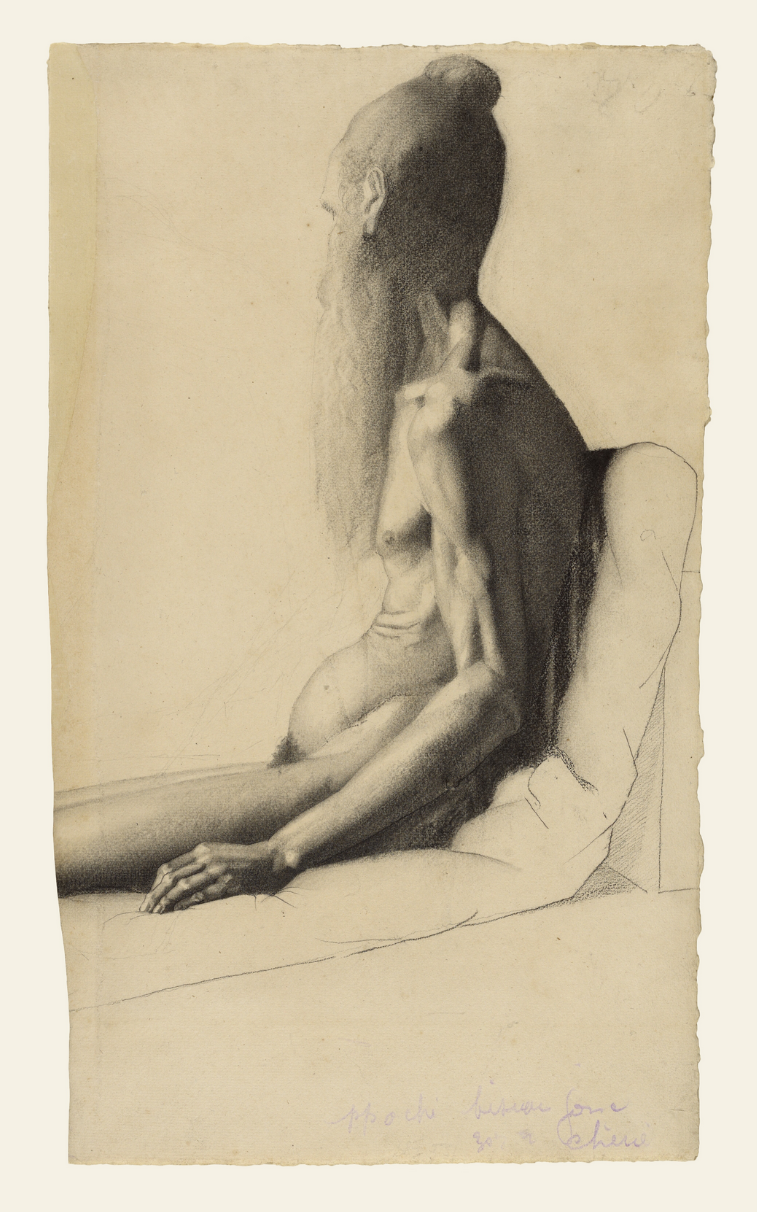 Seurat opened every painting with shadow. In his charcoal drawings, form emerges from density of tone, not from line. He drew Père Bainville from life, rubbing soft charcoal into the paper until the figure sat in a cloud of dust.
Small Oil Studies on Wood
In the 1880s, Seurat began taking small wooden panels outdoors, roughly fifteen by twenty-five centimetres. He called these sketches croquetons, from the French croquer — to jot down. The panels were light enough to hold in one hand while painting with the other.
A croqueton served as a record rather than a finished picture. The brushstrokes are broad, almost careless. The colours are pure and sharp. In the studies for Bathers at Asnières, the grass and the sky are indicated with a few sweeps of the brush, and the water already shimmers — Seurat places blue and pink strokes next to each other without blending them. The principle of pointillism is present here, even before the dots.
He made around seventy of these panels. For A Sunday on La Grande Jatte, he produced thirty-eight. For Bathers at Asnières, about thirty. Each panel works as a fragment of the future painting: a test of colour, light, and composition.
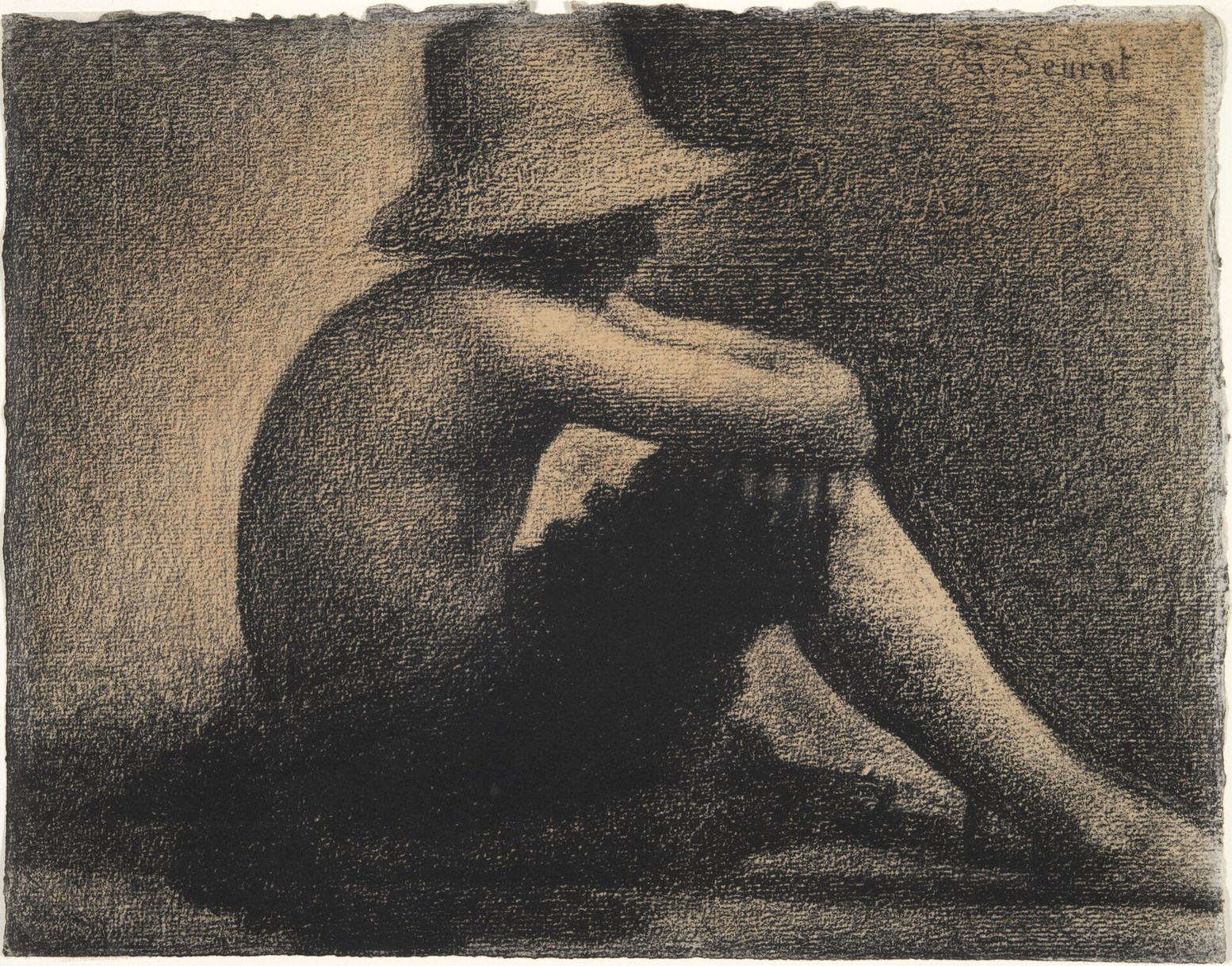 This small oil study on panel belongs to the Bathers at Asnières series. The pose was worked out in the open air, with broad strokes of pure colour placed side by side before they ever became dots.
From Panel to Canvas: Building La Grande Jatte
A Sunday on La Grande Jatte measures around two by three metres, painted on a canvas stretched in Seurat’s studio. The work took two years, from 1884 to 1886, and Seurat rebuilt the picture repeatedly during that time.
First came the drawings: twenty-eight charcoal and conté studies, where he searched for the poses of the figures — women with parasols, men in top hats, children, dogs. Then came thirty-three oil studies, each recording light at a different hour and in different weather. One early study was painted in the morning, and its shadows fall in the opposite direction from the shadows on the finished canvas.
Only after that did Seurat transfer the figures onto the large linen. A comparison of the final oil study at the Metropolitan Museum of Art with the completed work shows how much he shifted along the way. The strokes on the study are still loose and diagonal. On the finished canvas they have become dots — small, dense, almost mechanical. Underneath the dots, the original structure of light and shadow holds.
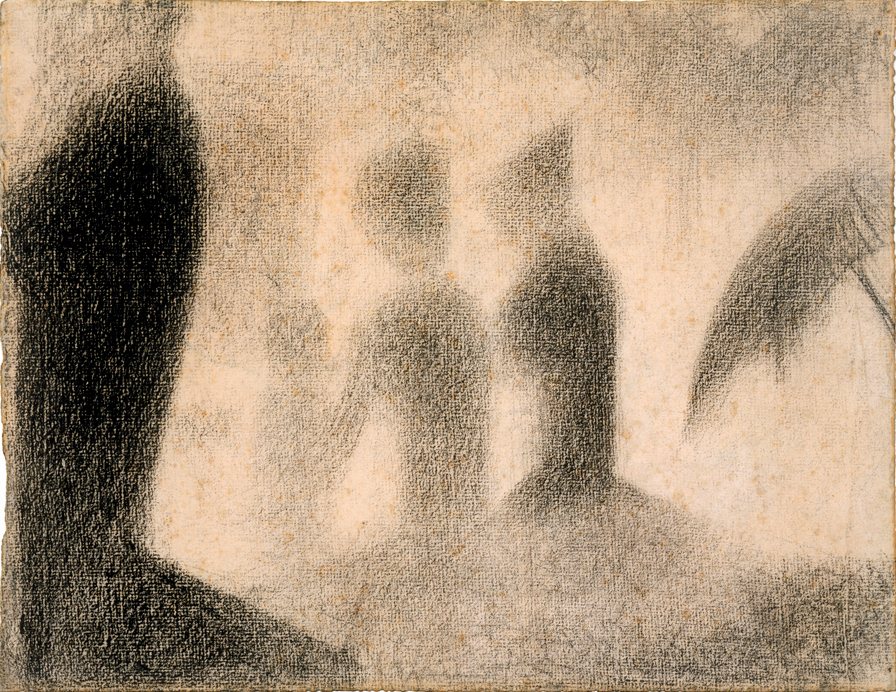 One of the many figure studies for A Sunday on La Grande Jatte. Seurat repeated each pose until the silhouette held without any background. Only then did he transfer it to the large canvas.
Close Up: What a Print Cannot Hold
Under a magnifying glass, La Grande Jatte reveals itself as a mosaic of thousands of tiny ridges of paint. Each dot has height. Some sit on top of two or three layers of earlier marks. Each one catches the light at a slightly different angle from its neighbour.
Step back a metre, and the ridges fuse into a shimmering, breathing surface — a vibration of colour. A digital print lays pigment in an even coat, and the eye reads it as flat. A hand-painted oil reproduction follows the movement of the brush, dot by dot, and keeps the physical surface that Seurat spent two years constructing.
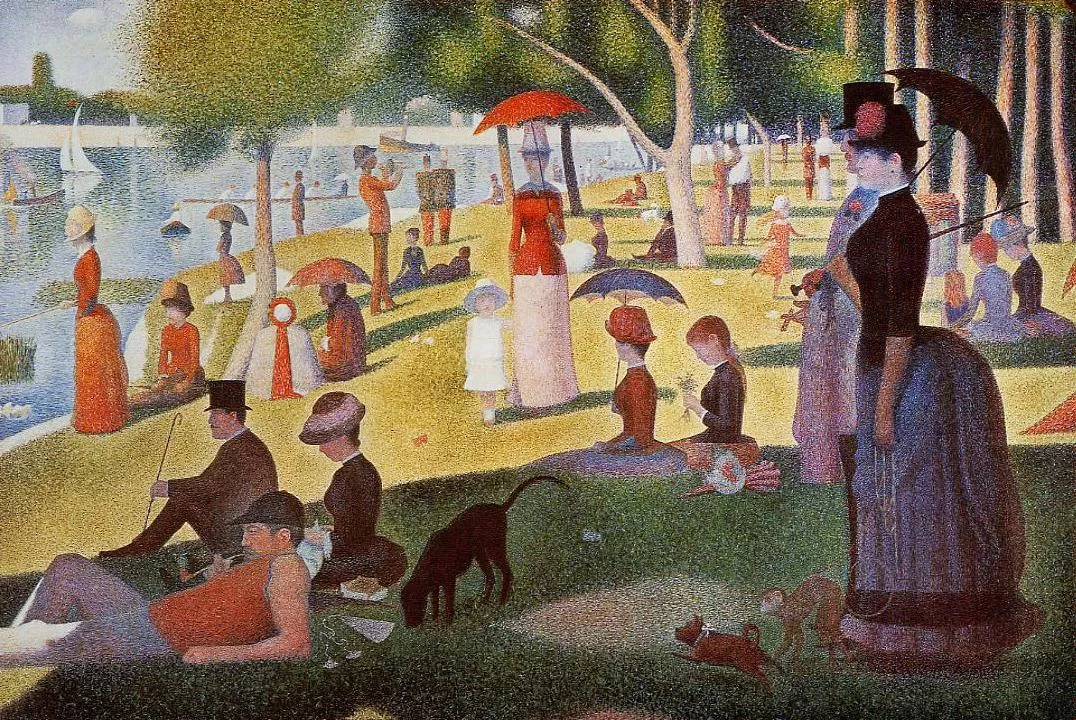 Seen whole, the painting reads as a shimmer. Seen up close, it is a mosaic of thousands of individual dots of oil paint, each one catching the light at a slightly different angle.
Where to Look First
To understand Seurat, start with the small oil studies. Seated Boy with Straw Hat from 1883 is a good entry point: water and greenery are still built from broad strokes of pure colour placed side by side. The dots have not arrived yet. The method is already visible.
Then return to La Grande Jatte. Find the woman with the parasol in the right corner. She stands still, and the space around her vibrates. That vibration is thousands of dots, each placed by hand by a painter who knew exactly what he was doing.
See A Sunday on La Grande Jatte as a hand-painted oil reproduction at oilpaintings.com. Each dot is reapplied by hand, layer by layer, in oil on canvas. View the painting
Images: Wikimedia Commons (public domain).